
Description
This online course is the second level of the three-level certification programme entitled ‘Organisational Development for Managers and Consultants’.
What I will learn?
- L'approche du constructivisme social et son application dans les domaines de la gestion, de la recherche scientifique de la politique etc.
- L'approche systémique pour comprendre le comportement des organisations.
- Les lois du changement dans les organisations.
- Comment gérer efficacement le changement dans une organisation.
- Comment planifier et réaliser des interventions dans des systèmes sociaux.
Course Curriculum
1. Introduction
This opening module presents the purpose and the architecture of the online programme. It shows how the e-learning modules, devoted to conveying knowledge, fit together with the face-to-face modules, devoted to learning the skills of professional helping and process consultation. You will also meet Joko, Mireille and Meiling, who will accompany you throughout the course, and you will choose a situation from your own practice that will serve as a common thread.
-
Welcome: what is this online programme for?
-
The architecture of the course: a common thread in three stages
-
Your travelling companions: Joko, Mireille and Meiling
-
Learning in this course: a user’s guide
-
Learning objectives of the programme
-
Organisation Development – some remarks on the subject of this course
-
Your reference situation (starting exercise)
-
Orientation quiz
-
Short glossary of basic concepts
2. Constructivism
Constructivism forms the epistemological basis of the modern applied social sciences. This unit provides an easy-to-understand introduction and shows the practical application of constructivism.
-
Introduction to the concept of constructivism
06:44 -
Quiz on constructivism
-
Constructivism and communication 1 (basic concepts)
-
Constructivism and communication 2 (tools)
3. Systems thinking
Participants become familiar with the basics of systems thinking and its practical application in working with groups, organisations and networks.
-
Systems in general (basic concepts)
00:00 -
Social constructivism and social systems (1) – multi-perspective construction through metaphors
-
Social constructivism and social systems (2): construction and reconstruction through narratives
00:00 -
Quiz on systems thinking
4. A closer look at the concept of (professional) “helping”
In his approach to “process consultation”, Edgar Schein made an important contribution to understanding the helper’s role and the psychological dimension of the helping relationship. In addition to the corresponding exercises in the face-to-face module, further important aspects are presented here – in particular the method of problem solving in the phase that Schein characterises by “confrontational questions”, which is marked by a stable relationship of trust between helper and client. This presentation thus complements the introduction to the topic of professional helping.
-
Introduction
00:00 -
Carl R. Rogers: helping as a growth-promoting relationship
-
Robert R. Carkhuff: helping as trainable performance
-
Allen E. and Mary Bradford Ivey: microskills and cultural intentionality
-
Gerard Egan: skilled helping as a staged problem-management process
-
Edgar H. Schein: helping in organisations, process consultation and humble inquiry
-
Quiz on module 4
5. Foundations for understanding groups, organisations and networks
-
General introduction to Module 5
-
Where we come from: a century of thinking about the phenomenon of “organisation”
-
The “binding agent” of social systems: communication
-
Business processes: the heart of the organisation
-
The shift from “organisation” to “organising” as the central axis of conceptualisation
-
Quiz on module 5
-
A “mini-epilogue” to this module
6. Interventions in social systems
-
The concept of intervention – the basics
00:00 -
The different levels and dimensions of interventions
-
A typology of interventions and advice on the attitude to adopt when implementing them
-
Reflections on the scope and intensity of interventions
-
Diagnosis: an intervention or a precondition for interventions?
-
Quiz on module 6
7. Change in social systems
-
Introduction
-
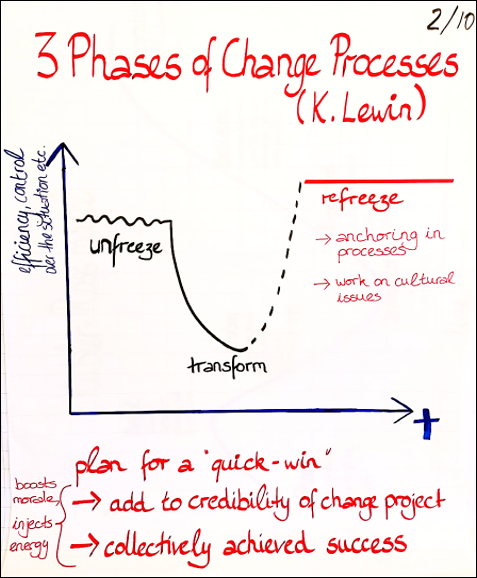
Process models for change in organisations
-
Leading change
-
Working constructively with resistance to change
-
Quiz on module 7
8. Change-enabling leadership
-
Introduction: why leadership in an OD course?
-
What a leader does: tasks, responsibility, communication
-
Leadership as a relationship: co-creation and mutual help
-
The inner attitude: responsibility, service, humility
-
Emotions during a change process
-
The learning organisation, psychological safety and the capacity for change
-
Quiz on module 8
-
Epilogue: what this foundation course cannot cover
Enrolled:0
Course level:Intermediate
Course Duration:
40h
Last Updated:October 28, 2026